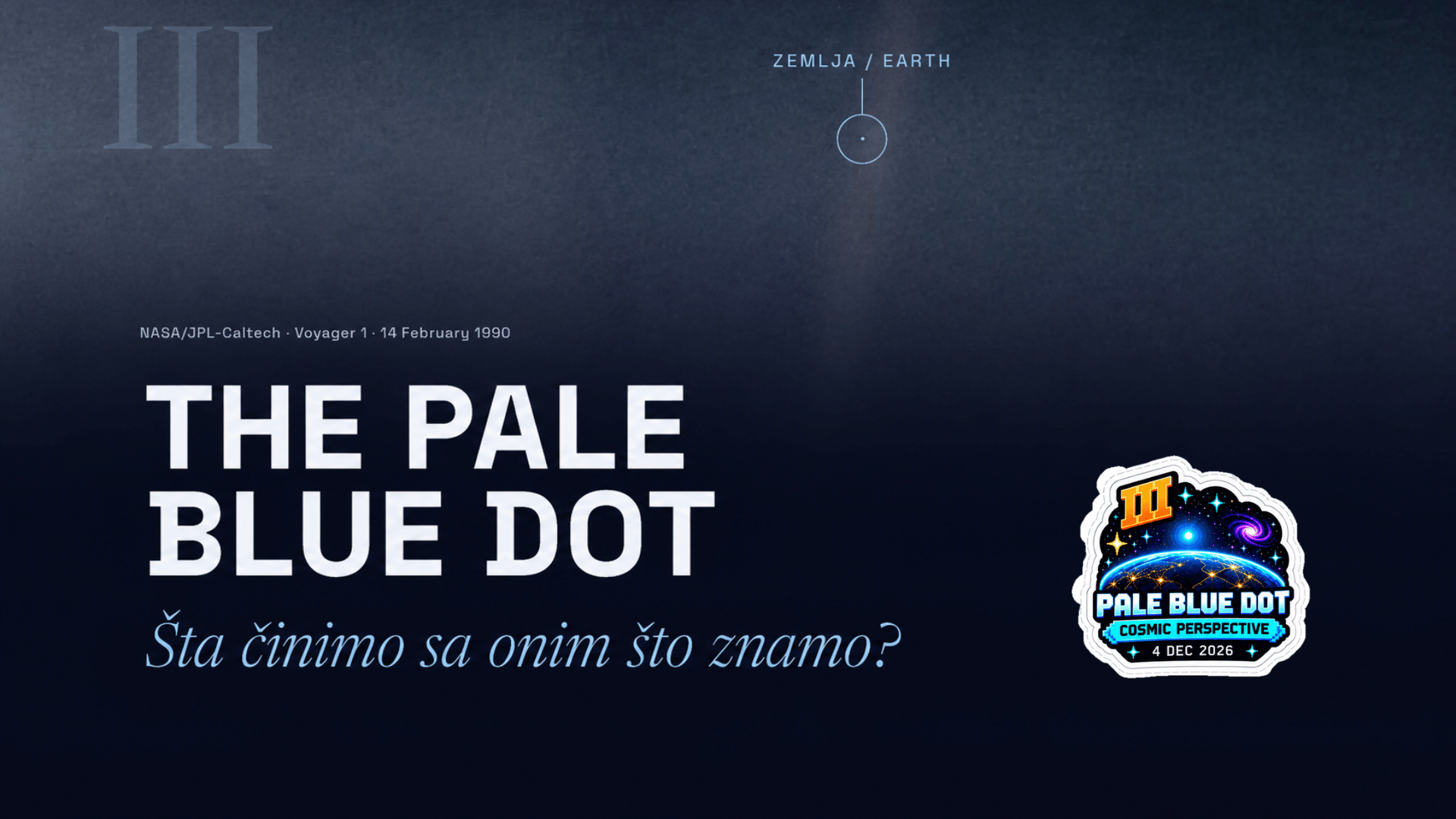
If we looked at Earth from a distance of six billion kilometres, our planet – so vast and seemingly boundless from where we are reading these lines – would appear as nothing more than an inconspicuous, tiny blue dot against a dark background. And yet, in the words of Carl Sagan: “That’s our home. That’s us. On it, everyone you love, everyone you know, everyone you ever heard of, every human being who ever was, lived out their lives.” Problems that seem so insurmountable to us from where we stand appear insignificant from that distance, while this tiny, barely visible dot, thanks to the life it sustains, becomes the loudest place in the quiet universe surrounding it.
How precious is life on our planet, really? Would it exist if the composition of the universe or our galaxy were just a little different? How has our growing knowledge of the universe changed the way we understand our planet, and what does this mean for future research? These are just some of the questions we will explore in the third lecture of the series Sagan Frontiers – Carl Sagan Month in Serbia 2026.
The lecture will be given by Tijana Prodanović, an astrophysicist, researcher and science communicator whose work also involves the application of artificial intelligence in the film industry. She has worked as a Full Professor at the Faculty of Sciences in Novi Sad and as an Associate Professor at the Faculty of Mathematics in Belgrade. She is the founder of NauKom, an association of science communicators, and has also served as the long-standing programme coordinator of Researchers’ Night in Novi Sad and as director of the Science Festival in Novi Sad.
Admission to the lecture is free and no registration is required.
The programme is jointly organised by the Palace of Science – Miodrag Kostić Endowment, the Institute of Physics Belgrade and the Astronomical Observatory Belgrade. It features four public lectures at the Palace of Science, taking place between 20 November and 10 December 2026. The programme is part of the international initiative of the European Astrobiology Institute (EAI), in collaboration with Europlanet.