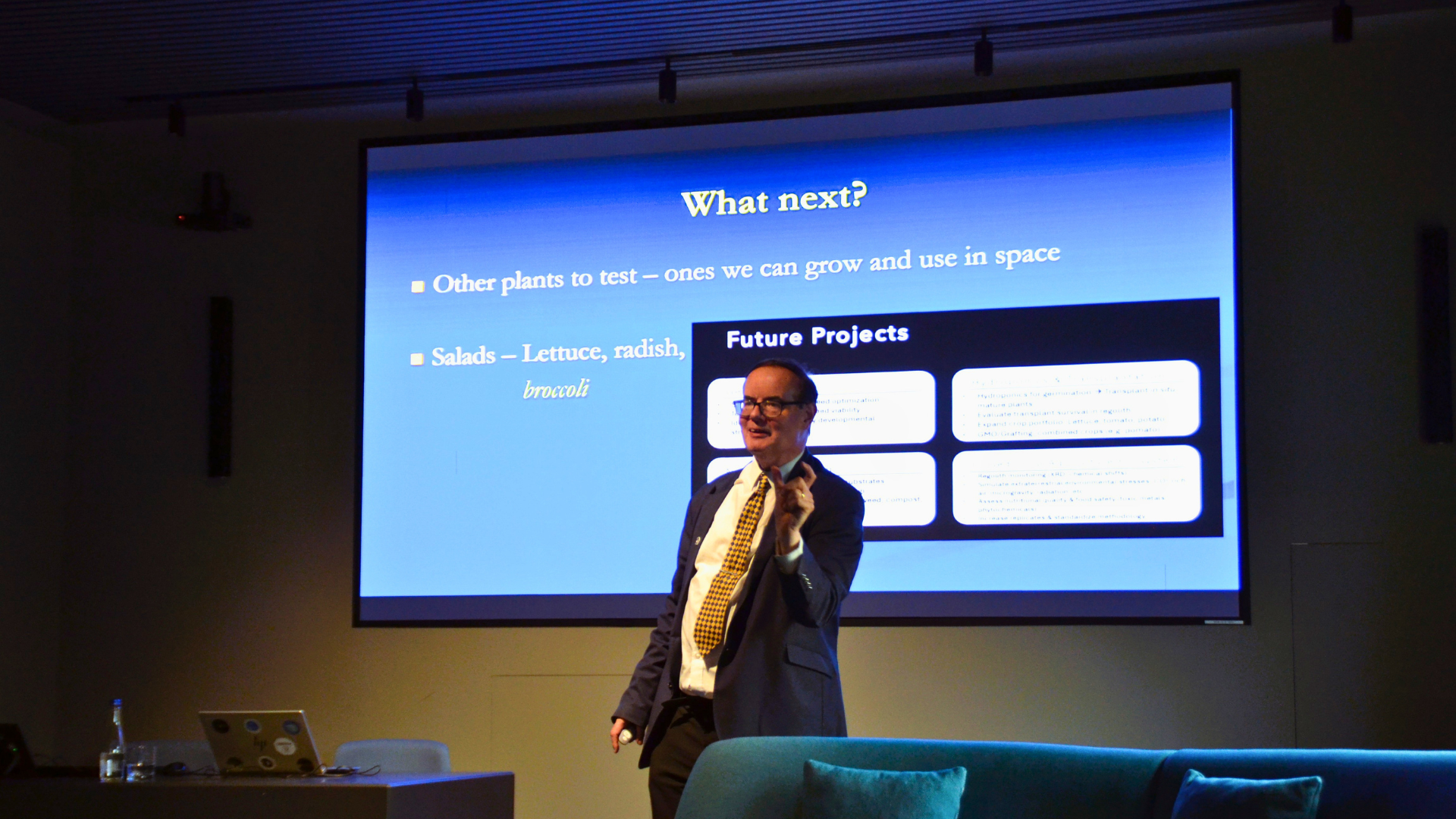
How will people feed themselves if they spend months travelling to Mars or living at a lunar base? Food cannot be supplied from Earth indefinitely: every kilogram of cargo increases the cost of a mission, storage space is limited and fresh produce has a short shelf life. Producing food locally will therefore be essential for long-term human life beyond our planet.
Professor Nigel J. Mason explored these challenges in his lecture “Agriculture in Space – Growing Food Beyond Earth”, held at the Palace of Science.
Professor Mason is Professor of Molecular Physics at the University of Kent and an internationally recognised scientist whose work spans molecular physics, astrochemistry, planetary science, atmospheric physics and radiation science. He has served as President of the Europlanet Society and as the founding President of the international non-profit association Europlanet AISBL. In 2007, he was appointed an Officer of the Order of the British Empire for services to science.
During the lecture, he introduced space agriculture as an emerging interdisciplinary field that brings together plant science and space research. Its fundamental questions sound simple: what can we grow in space, how can we grow it and what kind of infrastructure will we need? Answering them, however, requires an understanding of how plants, water, nutrients and microorganisms behave under conditions very different from those on Earth.
The first steps have already been taken. Plants are grown aboard the International Space Station to study how they behave in microgravity. Different types of vegetables, including lettuce, cabbage and peppers, have been successfully cultivated using the “Veggie” system. Fresh food provides crews with more than nutrients. The presence of plants and the opportunity to care for them also contribute to astronauts’ psychological well-being during long missions.
Growing plants on the Moon or Mars presents new obstacles. Regolith, the loose material covering their surfaces, is not the same as fertile soil on Earth. It contains no organic matter or developed microbiome, while Martian regolith may also contain toxic perchlorates that must be removed before food can be grown. Nevertheless, experiments with lunar and Martian regolith simulants show that lettuce, radishes, tomatoes, chickpeas, peas, spinach, quinoa and other plants can germinate and grow in them.
To turn regolith into a suitable growing medium, scientists will need to add organic matter, microorganisms and essential nutrients. Professor Mason also discussed the possibility of recycling water and crew waste, the role of the microbiome, and organisms such as earthworms, which loosen and aerate soil on Earth. The lecture also explored hydroponic systems, in which plants grow without soil while water and nutrients are carefully recirculated.
Radiation presents another significant challenge. Without the protection provided by Earth’s atmosphere and ozone layer, plants on the surface of the Moon and Mars would be exposed to solar and cosmic radiation. Potential solutions include designing shielded greenhouses and germination chambers, developing more resilient seeds and studying the effects of radiation under laboratory conditions.
Many questions remain open: how does microgravity affect germination, which plants can produce the most food using the least water, how can pollination be ensured, and how can we create a closed system in which water, nutrients and plant waste are continuously reused?
At the same time, research designed to support future life in space could contribute to the development of more resilient, efficient and sustainable agriculture here on Earth. The need to grow more food with less water, use nutrients more efficiently and develop plants that can withstand adverse conditions is not only a challenge for future space missions—it is one our planet already faces today.