A single day can begin on Earth and end among the stars — without ever leaving the heart of Belgrade.
The Palace of Science is more than a museum to simply walk through and observe. Here, an exhibit invites you to activate it, a question encourages you to ask it, and a phenomenon is something you can experience for yourself. Children and adults explore together: they build, operate, compare, make mistakes and try again. That is why a visit here never feels like a science lesson, even though you are bound to leave with new knowledge.
There is no single route you have to follow, nor do you need to see everything. The best visit is the one where everyone finds something that makes them stop and say, “Wait, how does this work?”
Start by discovering how we read emotions on someone’s face, set a tornado in motion, learn about the pioneers of Serbian robotics, take control of a rover on Mars and end your journey with a film beneath the Planetarium dome. All at one address: Kralja Milana 11.
The Only Spherical Cinema in Serbia
If you want to see a film in the spherical cinema at the Palace of Science, start planning your visit around the screening time. The film programme is designed for different age groups, so check the current schedule and book your tickets in advance. The programme includes science and educational films as well as original productions for different audiences — from family stories about dinosaurs and journeys through the Solar System to discovering constellations and learning how to navigate using a “celestial compass”. Once you have chosen your screening, it is easy to plan the rest of your day around it.
Good to Know
Allow around one to one and a half hours to explore the exhibition spaces. If you would like to visit the exhibitions and see a Planetarium film, plan for around two hours. And if you want to add an extra experience — the Bank of Memories, Children’s Science Corner or Extended Reality Portal — it is best to allow at least three hours.
The Permanent Exhibition Brings Together a Message about Humanity
The permanent exhibition is inspired by the Arecibo Message, a scientific greeting sent by humanity into space in 1974. Like the message itself, the exhibition brings together four major themes: Humans, Earth, Technology and Space, asking the same fundamental questions in different ways: Who are we? Where do we live? What are we capable of creating? And how far can we go?
Start with yourself. On the ground floor, dedicated to humans, explore how we perceive the world, learn and react. Can a robot learn how to play? How do we recognise an emotion on someone’s face? The exhibits show how machines attempt to understand human expressions while, at the same time, revealing more about our own abilities to perceive and communicate.
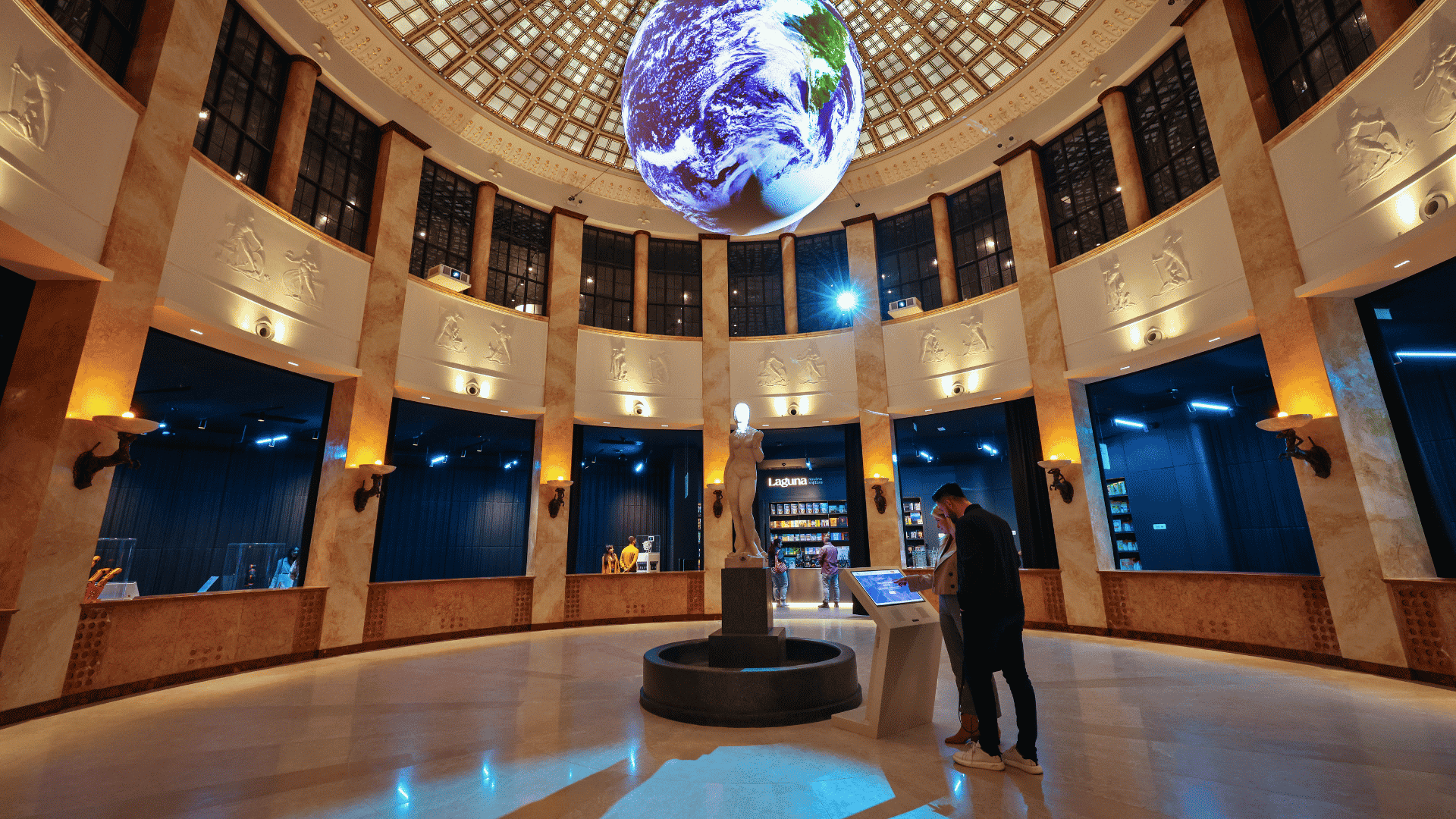
Explore Earth. On the first floor, natural processes are not simply explained — you set them in motion. Discover why the wind blows, how rocks are formed and how climate, soil and living organisms are connected. Then step up to the largest interactive globe in Europe, which uses NASA data to show our planet and other celestial bodies.
Discover technology developed in our own country. On the second floor, you will find the Belgrade Hand, a pioneering robotic system developed in Serbia, as well as a virtual space that brings together science and cultural heritage. With VR headsets, you can, among other things, step into the archaeological site of Viminacium or see the Danube from the perspective of the medieval Ram Fortress.
Take control of a mission. On the third floor, see an astronaut suit and explore equipment and models designed for space exploration before taking control of a rover and navigating the surface of Mars. Complete your journey through space with a unique experience beneath the Planetarium dome.
For the Youngest Explorers: Discovering Science Through Play
If you are visiting with a child aged five to seven, make sure to include the Children’s Science Corner in your plans. While shaping lakes and mountains in interactive topographic sand, children can watch a projection that shows how the landscape changes. They can also build small structures and test their strength on a platform that simulates an earthquake, or use simple programming commands to guide a robot through a maze.
Here, science becomes play. Children can explore independently, with support from their parents and science communicators. A separate ticket is required for the Children’s Science Corner, while the accompanying adult enters free of charge.
Every Visit Can Reveal Something New
The temporary exhibition changes throughout the year, bringing new perspectives, exhibits and programmes each time. The current exhibition, “My Micro-World”, takes you into the community of microorganisms that lives with us, in us and all around us — an invisible world that plays an important role in the development of our immune system and the balance of the entire organism.
Temporary exhibitions and their accompanying programmes — including workshops, expert-led tours and free lectures — make every visit to the Palace of Science different from the last. Before you arrive, check the current programme: you might be able to meet a researcher, take part in an experiment or explore a topic from the exhibition from an entirely new perspective.
Bank of Memories: Stories We Choose to Preserve
Inside the former bank vault, you will find the S.E.F. Gallery and the “Bank of Memories” exhibition. Stereoscopes transform archival photographs into three-dimensional scenes, while personal stories from the past are revealed through sound that you do not hear with your ears, but experience through your bones.
After exploring big questions about humans and space, this is a quieter part of the day, an opportunity to pause and think about the stories we chose to carry into the future. Admission to the S.E.F. Gallery is free.
A Break That Keeps the Exploration Going
When you need a break, stop by the Science Café on the ground floor. As you take in the central hall, a robotic arm prepares and decorates cappuccinos and hot chocolate, using cinnamon to draw motifs inspired by the Palace of Science.
Right next to it is the Science Bookshop, with books dedicated to science, children’s titles, board and educational games. It’s the perfect place to find a book that answers a question sparked by your visit and inspires you to keep exploring at home.
To Finish Off: Step into Extended Reality or Have Lunch Above the City
After your break, continue to Extended Reality Portal in the former bank vault. Gather your team for a VR Escape Room, play XR air hockey or test your speed and coordination on the interactive light floor. Extended Reality is open Tuesday to Sunday, from 12 p.m. to 8 p.m. Games and passes are purchased separately, and you can visit it independently of the Palace of Science exhibitions.
On weekdays, you can round off your visit with lunch at Marquise restaurant on the fifth floor, with a terrace overlooking central Belgrade. The restaurant is open Monday to Friday, from 10 a.m. to 5 p.m., and can be visited independently of the exhibitions.
Plan Your Visit
The Palace of Science exhibition area is open Tuesday to Friday from 10 a.m. to 6 p.m., and Saturdays and Sundays from 11 a.m. to 7 p.m. The Palace of Science is closed on Mondays.
An exhibition ticket includes access to the permanent and temporary exhibitions.
A family ticket for two adults and two children includes access to the permanent and temporary exhibitions.
Tickets for the Planetarium, Children’s Science Corner and Extended Reality are purchased separately. Combined tickets for the exhibitions and a Planetarium screening are also available.
Tickets can be purchased at the Palace of Science ticket office or online.
Before your visit, check the current programme, events, prices and available screening times on the Palace of Science website.
If you have any additional questions, you can always contact us at info@zaduzbinamiodragakostica.rs.
Whatever you choose to explore, give yourself a little extra time. The best part of a visit to a science museum is sometimes the unexpected discovery that makes you stop and look again.
See you at the Palace!