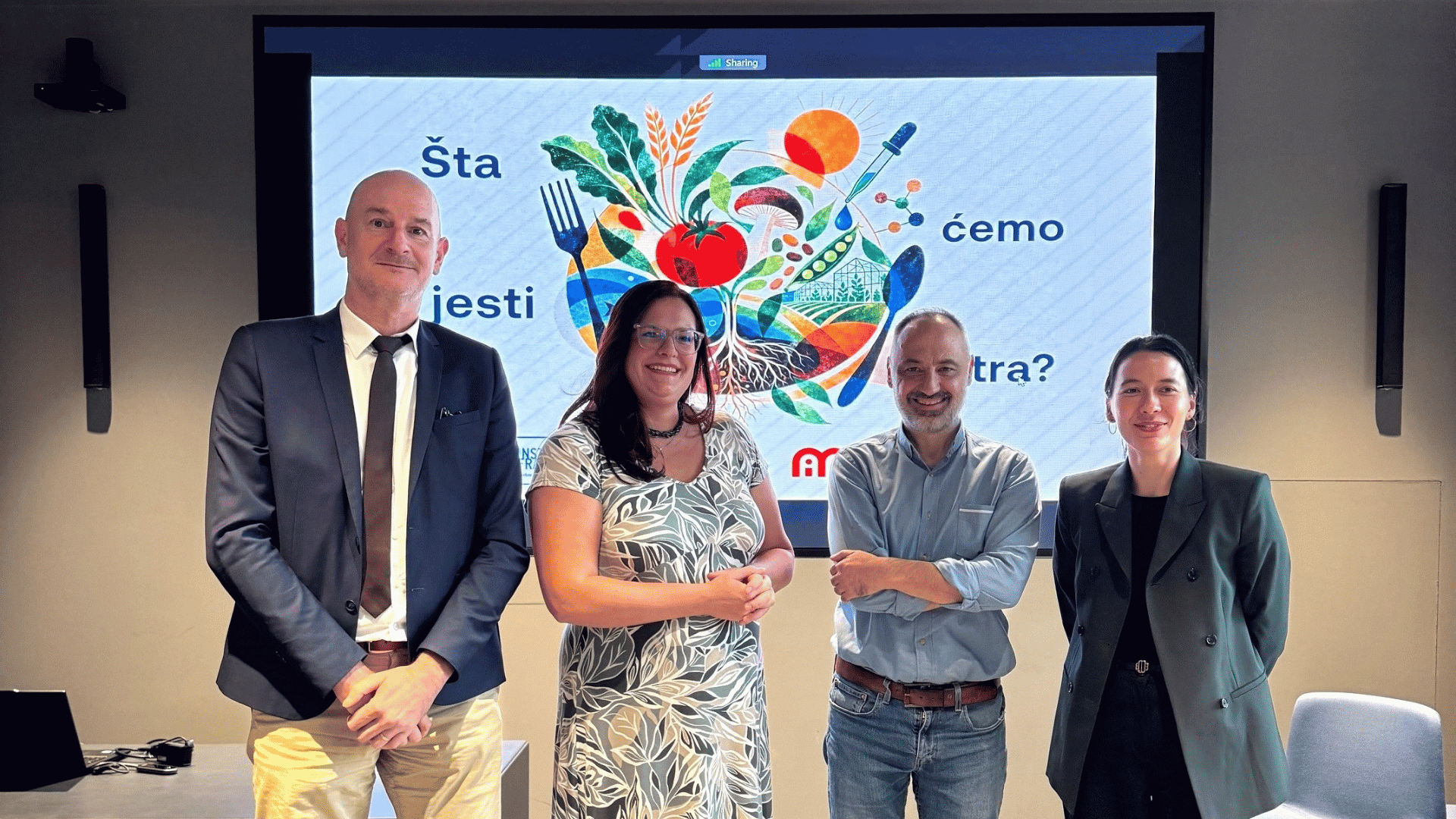
Fête de la Science, a festival that has been bringing together scientists, educators, researchers, and members of the public around the world for more than three decades, was held in Serbia for the first time this year. The Palace of Science – Miodrag Kostić Endowment had the honour of hosting the event, organised in cooperation with the French Institute in Serbia, the Institute for Medical Research, the Center for the Promotion of Science, and the Palace of Science.
This year’s festival focused on food, its significance, and its role in contemporary society, under the slogan Tasteful Science. Over two days, students, teachers, and members of the public had the opportunity to explore, through science workshops, discussions, and hands-on activities, how climate change affects food production, how our eating habits develop, and how science can contribute to a more sustainable future.
What Will We Eat Tomorrow?
One of the programme’s key events was the panel discussion What Will We Eat Tomorrow?, dedicated to the links between climate change, agriculture, nutrition, and everyday consumer choices. The discussion featured Dr Jelena Milešević, Senior Research Associate at the Institute for Medical Research; Alexandre Martinez, Adviser for Agriculture and Food Production for the Western Balkans at the Embassy of France in Serbia; and Professor Vladimir Đurđević, Full Professor at the Institute of Meteorology, University of Belgrade. The panel was moderated by Lidija Foster, Cooperation Attaché at the Embassy of France in Belgrade.
The discussion highlighted that the future of food depends not only on how much we can produce, but also on preserving natural resources, maintaining nutritional quality, and ensuring access to food. Droughts and other effects of climate change influence both agricultural production and food prices, while choosing local and seasonal produce and reducing food waste are important steps towards more responsible eating habits.
From the Classroom to a More Sustainable Future
Education and the exchange of experiences among teachers were also important parts of the programme. At a workshop on sustainable food systems held on October 7, teachers explored approaches that connect formal and non-formal education, as well as ways schools can become active spaces for investigating and reflecting on more sustainable food production. Participants exchanged ideas and worked together to develop practical educational activities they could use with their students. The workshop was organised by the Institute for Medical Research in Belgrade and Ellinogermaniki Agogi in Athens as part of the European FutureFoodS partnership.
Through activities designed for students, teachers, and the wider public, the first Science Fest in Serbia demonstrated how science can create opportunities to discuss issues that affect our everyday lives. From the way we produce and choose food to the resources we consume and the food we waste, questions of sustainability remind us that the future of food systems is shaped both by scientific knowledge and by the decisions we make every day.