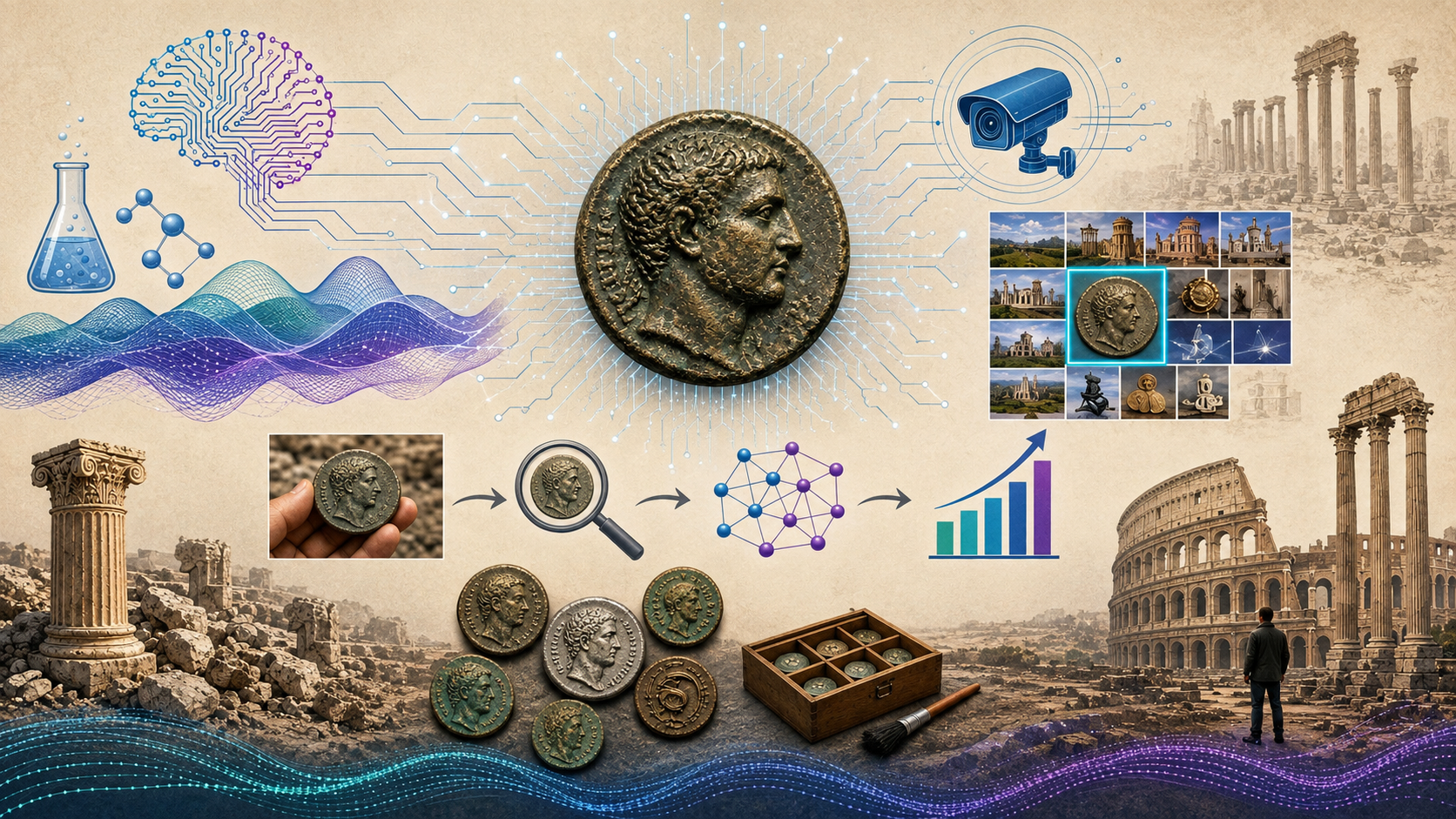
In the field of archaeology, Roman coins represent an important source of information about the history, politics, economy, and culture of the Roman world. However, the great diversity of coin types, combined with differences in their preservation and degree of damage, makes the identification of Roman coins a challenging task. In recent years, advances in artificial intelligence have enabled the development of algorithms capable of analyzing information contained in images and visual recordings. In this way, artificial intelligence offers new possibilities for supporting the identification process, connecting traditional approaches in numismatics with modern digital technologies.
The lecture will present the application of artificial intelligence to the recognition and classification of Roman coins based on digital images, with a particular focus on deep learning methods. Through practical examples, it will demonstrate how artificial intelligence algorithms learn to distinguish between different coin types, which visual features contribute to their identification, and how various challenges, such as damaged specimens and limited data availability, affect their performance. Dr. Vladislava Krsmanović will discuss the possibilities and limitations of artificial intelligence in addressing this problem and demonstrate how bringing together technology and archaeology can open up new perspectives for the preservation of cultural heritage.
Dr. Vladislava Krsmanović is a Research Associate at the Innovation Center of the School of Electrical Engineering, University of Belgrade, where she completed her bachelor’s, master’s, and doctoral studies. For more than 10 years, her research has focused on the development and application of data analysis algorithms, with particular interest in machine learning, deep learning, and decision support systems. Her research is based on interdisciplinary collaboration with professionals from a wide range of fields. Her work to date has encompassed diverse applications of artificial intelligence, from medical data analysis to image analysis and the application of advanced algorithms in archaeology.
Admission to the lecture is free, and no registration is required.